
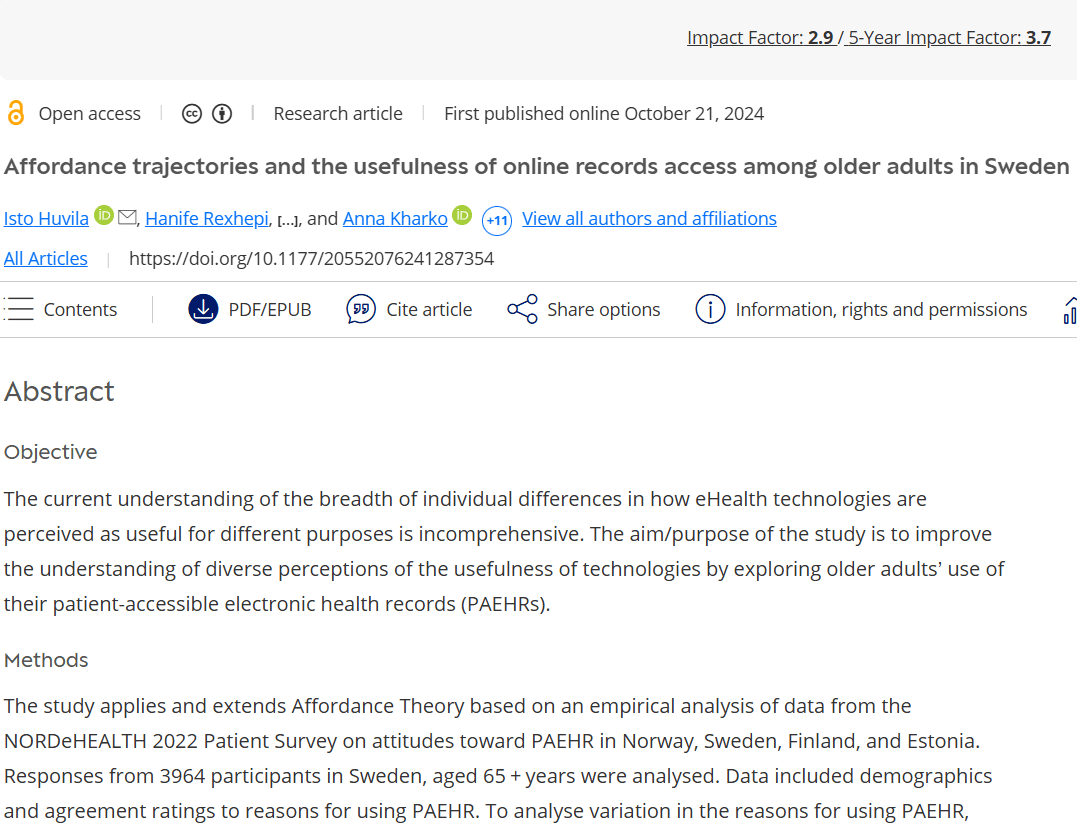
In today’s rapidly evolving digital health landscape, electronic health records (EHRs) offer patients better control over their health data. However, how individuals, especially older adults, perceive and utilize these technologies varies greatly. In a recent NORDeHEALTH study published in Digital Health, “Affordance trajectories and the usefulness of online records access among older adults in Sweden”, Isto Huvila and co-authors explore these differences by analyzing the perceptions of Swedish older adults (65+) towards patient-accessible electronic health records (PAEHRs) using Affordance Theory.
Study Overview
The research draws on data from the NORDeHEALTH 2022 Patient Survey. The aim was to understand why older adults use PAEHRs, focusing on gender, age, and prior encouragement to use these systems. This study extends Affordance Theory—essentially exploring how technology’s design shapes its perceived usefulness—to examine eHealth from the user’s perspective.
Key Findings
The results reveal multiple “affordance trajectories,” or ways older adults derive value from PAEHRs, based on their individual needs. Most older adults found PAEHRs useful for understanding health issues, reviewing medical history, and ensuring clarity on their doctor’s instructions. Interestingly, men were more likely to share health data with family or friends, while women were slightly more inclined to check for errors in their records, though both groups did so infrequently.
While age did not significantly affect reasons for using PAEHRs, prior encouragement to use the system played a role in determining how actively it was used.
Extending Affordance Theory
This study contributes to the broader field of eHealth by applying Affordance Theory to understand individual differences in the use of PAEHRs. It highlights that older adults’ engagement with health technologies is not one-size-fits-all but is shaped by various personal factors like gender, previous encouragement, and health needs.
Implications for eHealth Design
The findings suggest that designers and health practitioners should consider the diverse ways individuals interact with eHealth tools. By recognizing that older adults use PAEHRs for different purposes, we can tailor these systems to improve usability and satisfaction, enhancing the overall healthcare experience for aging populations.
In conclusion, this research underscores the importance of understanding the nuanced ways older adults perceive and use health technologies, which can lead to more inclusive and effective eHealth solutions.
This article reflects an exciting intersection of Affordance Theory and eHealth, emphasizing the need for a user-centered approach in designing digital health tools for older adults.
 NORDeHEALTH